


5 Benefits of Fostering Open Collaboration in the Point-of-Sale Industry
Collaboration in the point-of-sale (POS) industry is needed now more than ever. The complexity of an interconnected world linked by ever-evolving technology has shifted the nature of POS from streamlined individual processes to creative and collaborative cross-functional innovation.
While strategic alliances tend to be overlooked, they can do wonders for your organization and are one of the most meaningful ways to attract new business. Multiple heads are better than one, and, in many cases, multiple companies are better than one – especially when they combine resources or share expertise to build new business for one another. Unfortunately, many organizations default to an individualistic way of thinking and operating; however, it’s important to note that alliances are just like networking. In a sense, it’s not what you know; it’s who you know.
The POS industry is just one industry where collaboration is a must. So, join us as we explore the top five benefits of fostering open collaboration in the industry.
Access to New Audiences
Over time, businesses gradually build a substantial list of interested customers and prospects. By partnering with these businesses who are closely aligned with what you sell, you can tap into their existing audiences and reach a highly targeted group of individuals. In addition, when your partner promotes your brand, you instantly earn the trust of the existing audience, making it easier to grow your base of prospects and customers.
Market Faster
When you utilize a strategic partner, people tend to hear about your organization faster than if you go it alone. In addition, your customers may find you more quickly if you're working with a brand they’re already familiar with. In short, you reach buyers quicker than if you tried to do all your business building alone.
Enhance Your Reputation
Collaborating with other companies within the POS industry can also enhance your organization’s reputation, as people may trust the business you’re partnering with because of the reputation they’ve built. As a strategic partner, you can utilize their years of reputation building to your advantage to boost your brand image and leverage their positive image to create a stronger impression on new and potential customers. As your partner promotes your product, service, or company more, your reputation will grow.
Fill Competency Gaps
You can’t do it all alone. As much as you may like to know everything, you don’t, and that’s okay. By collaborating and forming partnerships, you can fill any competency gaps which take a burden off your organization’s plate. It also ensures that each task is deployed in the best, most effective manner.
Increase Competitiveness
Every business has competition. It’s healthy and means there is demand. However, partnerships can help beat the competition and attract a larger share of the market. By collaborating with other organizations in the POS industry, you gain more exposure, have the potential to offer a better product or service, and position your business more strategically in the marketplace.
While collaborating with other organizations within the same industry may seem risky at first glance, it’s essential to understand that competitive renewal depends on building new process capabilities and winning new product and technology battles. Collaboration can be a low-cost strategy for doing both.
About Pioneer Solution Inc.
Founded in 1994, Pioneer is headquartered in California with offices in Asia and distributors worldwide. We focus on designing and supplying integrated/embedded touchscreen solutions for multiple vertical markets, including healthcare, hospitality, retail, and industrial. Our products are designed to have a long shelf life (a minimum of 5 years) and serviceability (a minimum of 7 years). With our extensive engineering background, we can also work with our customers in designing a custom product from start until production, which may involve custom molding, system board engineering, laboratory or agency approval, assembly, and production. This expertise has resulted in numerous high-profile OEM projects.


Why is Opting for a POS System with a Rugged Design the Way to Go?
In the past, the word “rugged” was typically used to describe something large and bulky. However, these days, a device’s ruggedness isn’t necessarily dependent on its size. Instead, it can be determined by the power of the materials used and its thoughtful and innovative design. If done right, these factors can contribute to a durable yet sleek product.
Pioneer produces several rugged devices, including tablets, kiosks, point-of-sale accessories, and mobile computers. All our products are designed to withstand above-average damage and tested for their ability to survive large amounts of dust, multiple touches, and messy spills. Several of our products are also medical grade and proven to thrive within hospitals and other healthcare environments.
So, whether you’re a reseller or an organization looking for a touchscreen solution for your business, Pioneer’s rugged hardware is the way to go. Here’s why:
Versatility
Pioneer’s POS systems have a small footprint and less cabling to manage than most hardware solutions, making them an excellent choice for those with minimal counter space. In addition, their footprints and overall designs make them easy to move to new locations when needed. They can be configured for applications in various industries, including retail, healthcare, hospitality, and education.
Durability
The rugged designs of Pioneer systems help them withstand harsh environments and resist damage from dust particles and liquids. Using rugged devices such as these reduces the total cost of ownership (TCO) and paves the way for a healthier return on investment (ROI), as neither parts nor the devices themselves will require frequent replacement.
Powerful Performance
There is a common misconception that the larger the system, the more powerful it is. Pioneer systems debunk this myth, as they are built with the computing capabilities necessary for end-users to get the job done efficiently. Combined with the ability to accommodate multiple peripherals, their features offer extreme functionality and power that rivals systems with larger footprints.
Sleek Aesthetic
Choosing a system with a rugged design and a small footprint allows end-users to get a sleek, aesthetically pleasing look and feel without sacrificing functionality. Pioneer’s solutions have an intuitive design that helps end-users work more efficiently, productively, and accurately. So if you’re considering a POS upgrade, remember that bigger doesn’t always mean better. You can still achieve the ruggedness you’re after with a smaller footprint device that also meets your needs regarding space occupancy and aesthetics.
About Pioneer Solution Inc.
Founded in 1994, Pioneer is headquartered in California with offices in Asia and distributors worldwide. We focus on designing and supplying integrated/embedded touchscreen solutions for multiple vertical markets, including healthcare, hospitality, retail, and industrial. Our products are designed to have a long shelf life (a minimum of 5 years) and serviceability (a minimum of 7 years). With our extensive engineering background, we can also work with our customers in designing a custom product from start until production, which may involve custom molding, system board engineering, laboratory or agency approval, assembly, and production. This expertise has resulted in numerous high-profile OEM projects.
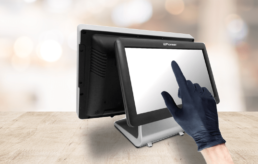
The Importance of Glove Compatibility for Touchscreen Solutions
The spread of COVID-19 has caused many people to rethink their daily lives and how they keep their technology clean. This is especially true for objects that receive a large number of daily touches, such as point-of-sale (POS) hardware. Since it can be challenging to keep POS devices clean throughout the day, wearing gloves seems to be a logical alternative to using harsh chemicals that may ruin displays or pin pads.
As the demand for gloves has increased amongst healthcare professionals and frontline workers worldwide, as well as in retail environments such as grocery stores and shopping centers, a major question comes to mind. Is your POS technology compatible with gloves?
While the urgency to provide glove-compatible touchscreens seems high, millions of retail and healthcare organizations still lack glove-compatible touchscreens in their offices and stores. The first step for changing the trend is educating POS users on what constitutes touchscreen compatibility.
How Touchscreens Work
Most of us are familiar with touchscreens. We use this technology daily with our phones, computers, at the ATM, and even out to eat at restaurants now that many of them have implemented touch display ordering. Although we're constantly tapping and swiping on our screens all day long, very few of us have probably ever wondered what it takes for touchscreens to work. There are two common touchscreens that we typically interact with: resistive and capacitive.
Resistive
Resistive touchscreens do precisely what their name implies. They "resist" your touch, and as you press harder on their screens, you may even be able to feel them bend slightly. This is because the screen is made up of two electrically conductive layers. When your finger hits the screen, the two layers get pressed together, and the electrical current changes. At this point, the software recognizes a change in the current at these coordinates and carries out the function that corresponds with that spot.
Capacitive
Capacitive touchscreens are the style we interact with the most, and unlike resistive touchscreens, they don't use the pressure of your finger to create a change of flow of electricity. Instead, they are compatible with anything that holds an electrical charge. So as your finger or another object touches the screen, an electrical charge is transferred to create a voltage drop on that point of the screen. The software then processes the location of the voltage drop and carries out the function that corresponds with that spot.
What Gloves Work on What Touchscreens?
A big question when selecting gloves today is touchscreen compatibility. However, understanding what constitutes touchscreen compatibility is not straightforward, and there is more to it than just the glove. Because resistive touchscreens only need a local pressure point to initiate a signal, it doesn't matter whether you're wearing gloves or not. Disposable gloves and thinner coated seamless knit gloves work best on capacitive touchscreens because they have a higher level of conductivity that can influence screen functionality and responsiveness.
What Solutions are Currently Available?
Pioneer is dedicated to addressing this issue throughout the United States, especially when equipping healthcare personnel and other businesses with the technology they need to operate safely. Our integrated/embedded touchscreen solutions are designed to withstand harsh and demanding environments, protect against liquid spills, withstand millions of touches, and are glove-compatible.
Pioneer's 15" CYPRUS is one example of a touchscreen that allows touch by gloves. It is a versatile solution, making it the perfect design for retail and hospitality environments of all kinds. It can be configured to meet your application requirements and budget and can run as a thin client on a solid-state disk (SSD) or support more complex applications under Windows or Linux. Plus, every CYPRUS's screen is protected against liquid spills and lasts millions of touches.
For more information about our glove-compatible touchscreen solutions or Pioneer in general, don't hesitate to get in touch with our team here.
About Pioneer Solution Inc.
Founded in 1994, Pioneer is headquartered in California with offices in Asia and distributors worldwide. We focus on designing and supplying integrated/embedded touchscreen solutions for multiple vertical markets, including healthcare, hospitality, retail, and industrial. Our products are designed to have a long shelf life (a minimum of 5 years) and serviceability (a minimum of 7 years). With our extensive engineering background, we can also work with our customers in designing a custom product from start until production, which may involve custom molding, system board engineering, laboratory or agency approval, assembly, and production. This expertise has resulted in numerous high-profile OEM projects.

Pioneer Provides Gateway Ticketing with All-in-One Solution for Attractions Customers
Pioneer Provides Gateway Ticketing with All-in-One Solution for Attractions Customers
City of Industry, CA – March 3, 2021 – Pioneer Solution Inc. values the many business relationships we have built over the years, including our relationship with Gateway Ticketing Systems, Inc.
Gateway Ticketing has been revolutionizing the ticketing industry for over 30 years, working with the world's top theme parks, zoos, aquariums, and museums. These entertainment organizations across the globe have trusted Gateway Ticketing’s Galaxy® software for ticketing, admission control, group sales, membership/season pass, and CRM solutions to drive revenue and increase efficiencies throughout their facilities.
According to Greg Banecker, Senior Marketing Manager at Gateway Ticketing, they did not have an All-in-One solution that housed a printer before working with Pioneer Solution. Gateway Ticketing chose to partner with Pioneer after several of their attraction customers asked them to support Pioneer’s line of All-in-One units with built-in printers.
“We finally decided to reach out and test a few units,” Greg said. “We found that the units exceeded the requirements needed to run our Galaxy Guest Experience & Ticketing software, and the support structure was in place for us to move forward with offering these to our customers.”
According to Greg, the team at Gateway Ticketing received several large orders early on in their partnership with Pioneer. “We had multiple orders right out of the gate,” he said. “It was because of Pioneer’s reputation within our industry for quality products that meet the needs of attractions.”
Gateway Ticketing values Pioneer’s commitment to building relationships with not only their team but also their customers. “Pioneer put in the extra time to attend our User Group Meetings and build relationships with our customers to truly learn what attractions were looking for in their use of Galaxy and the POS hardware,” Greg said.
Now, when Gateway Ticketing is having discussions with customers and prospects, Pioneer is usually brought up in the mix. They know they can count on Pioneer to provide reliable products that exceed the expectations of their customers in the attractions industry.
About Pioneer Solution Inc.
Founded in 1994, Pioneer is headquartered in California with offices in Asia and distributors worldwide. We focus on designing and supplying integrated/embedded touchscreen solutions for multiple vertical markets including healthcare, hospitality, retail, and industrial. Our products are designed to have a long shelf life (a minimum of 5 years) and serviceability (a minimum of 7 years). With our extensive engineering background, we can also work with our customers in designing a custom product from start until production, which may involve custom molding, system board engineering, laboratory or agency approval, assembly, and production. This expertise has resulted in numerous high-profile OEM projects.

Intelligent Touchscreen Systems
There are many point-of-sale hardware solutions on the market, but none of them compare to Pioneer’s Intelligent Touchscreen Systems. If you’re a long-term partner or customer of Pioneer Solution, you’ve likely heard us use this phrase before: Intelligent Touchscreen Systems. This is a phrase that we believe fully encompasses the unique difference our technology brings to the market.
At Pioneer, we value quality, efficiency, durability, and support, and we strive to incorporate these values into each of our products.
Quality
In a world where technology across many industries is becoming less reliable and efficient, Pioneer brings long-term quality and value. For example, Pioneer’s intelligent touchscreen systems have a meantime failure rate of 30 million touches, the lowest failure rate in the industry.
Efficiency
Our main goal at Pioneer is to help increase business efficiency for our customers and partners. We do so by making sure you have access to the best products, tools, and support. Plus, the speed of our point-of-sale solutions is the best in the industry, which helps your team or your customers’ teams do business better and faster.
Durability
With Pioneer, you never have to worry about hardware failures. All our solutions are solidly constructed and expertly engineered to fit the specific needs of each industry application. Plus, our products have the longest life cycle in the industry with a minimum of five years.
Support
When you work with Pioneer, not only do you gain access to our leading intelligent touchscreen systems, but you also gain access to our dependable team. No matter the scenario, you can always count on our people to work for you behind the scenes and on the front lines. Think of us as an extension of your own team.
How can Pioneer provide the quality, efficiency, durability, and support you need? Learn more about our Intelligent Touchscreen Systems for retail environments at our website.
About Pioneer Solution
Based in City of Industry, CA, Pioneer Solution Inc. is a global leader in supplying integrated touchscreen solutions for multiple vertical markets including retail, healthcare, hospitality, and industrial.
Pioneer has built an exceptional reputation with its customers and solution partners for superior flexibility and responsiveness to customer needs including short lead times, long product life cycles (minimum of 5 years), easy customization, and quick turnaround. Pioneer sells through qualified technology resellers throughout the US and globally.

New Year, New Hope
2020 is a year that will go down in history as one of the most unprecedented and challenging years yet. As a nation, we faced many obstacles - including the COVID-19 pandemic, intense political division, and an economic crisis – just to name a few. While there were a lot of lows throughout the year, we are confident that 2021 will include its fair share of high notes.
While no one predicted 2020 to play out the way it did, it taught us that the adversity we face and the resilience in which we respond to challenges has the power to shape our relationships, businesses, and lives as a whole. With each challenge, we are given the opportunity to persevere, learn, and grow into stronger, more compassionate, and grateful individuals. Those are the lessons Pioneer is taking with us into 2021 and for many years to come.
There is no question that the COVID-19 pandemic has dramatically changed the way in which we conduct our daily routines. From wearing masks to social distancing, this year has looked quite a bit different than years prior. Pioneer is proud to have played a role in the efforts to reduce the spread of the virus by introducing the Passport, a freestanding temperature screening station that meets the latest FDA guidelines. We also hosted multiple webinars and strived to be a reliable resource to our customers.
While Pioneer made great advancements this past year in the touchscreen solutions market, there is always more to be done. Here are a few goals we have for 2021:
Continue to Invest in New Technology
At Pioneer, we are committed to researching new and upcoming trends, as well as investing in the very best technologies for our customers. Our goal at Pioneer is to provide you with certainty, reliability, durability, and responsivity when you need it. Our technology is known for its ability to last, and for providing functionality in varied environments.
Serve as a Resource to Customers
New and continued training is a top-priority goal for Pioneer as we make our way into 2021. We are focused on being a resource to our customers, providing them with everything they need to make the most out of their Pioneer products. We provide customers with tools such as cleaning, mounting and video guides, as well as comprehensive user manuals. We are also dedicated to providing you with the most up-to-date information regarding COVID-19.
Help Your Business Thrive
At Pioneer, your success is our success. That’s why we are focused on designing and supplying integrated/embedded touchscreen solutions for multiple vertical markets including healthcare, hospitality, retail, and industrial. We provide all of our customers with built-to-last products - and if you’re looking for something more tailored to your specific use case, we work with you to design a custom product from start until production.
Interested in one of Pioneer’s many touchscreen solutions? Visit our website to learn more or contact us today to get started! We are excited for all that 2021 has in store.
About Pioneer Solution Inc.
Founded in 1994, Pioneer is headquartered in California with offices in Asia and distributors worldwide. We focus on designing and supplying integrated/embedded touchscreen solutions for multiple vertical markets including healthcare, hospitality, retail, and industrial. Our products are designed to have a long shelf life (a minimum of 5 years) and serviceability (a minimum of 7 years). With our extensive engineering background, we can also work with our customers in designing a custom product from start until production, which may involve custom molding, system board engineering, laboratory or agency approval, assembly, and production. This expertise has resulted in numerous high-profile OEM projects.

Video: Inside Long-Term Care 2019
Is your facility powered up to handle the critical computing necessary in the modern long-term post-acute care (LTPAC) community?
Ian Gelenter, senior vice president at Pioneer, discusses what is required and how it affects outcomes and real-time documentation in this video interview for McKnight’s Long-Term Care News.
Watch the video to learn more about mastering PDPM with real-time clinical documentation.


Why Having the Right Point of Care (POC) Devices is Essential for CMS’s New Patient Driven Payment Model (PDPM)
In the senior care industry, one of the biggest topics of conversation lately has been the new Patient Driven Payment Model (PDPM) from the U.S. Center for Medicaid and Medicare Services (CMS).
On October 1, 2019, skilled nurse facilities (SNFs) will be required to use this case-mix classification model in order to classify SNF patients in covered Part A stays.
PDPM in a Nutshell
The new PDPM is replacing the RUG-UV scores as a reimbursement model. Currently, there’s a heavy reliance on therapy minutes as it relates to care; moving forward, the importance will be centered around the actual care provided and the positive health outcomes of the patient.
CMS explains that “PDPM eliminates [the incentive of SNF providers furnishing therapy regardless of a patient’s needs, goals, or characteristics] and improves the overall accuracy and appropriateness of SNF payments by classifying patients into payment groups based on specific, data-driven patient characteristics, while simultaneously reducing administrative burden on SNF providers.”
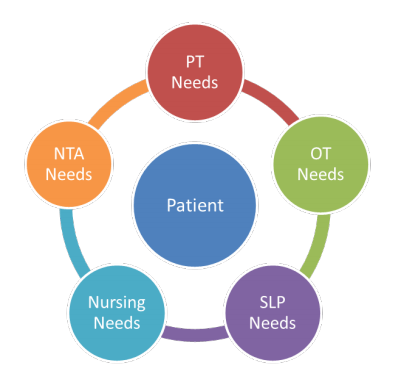
Unlike RUG-IV, which assigns patients to different therapy payment groups based on the volume of therapy services, PDPM uses what CMS calls “clinically relevant factors” to determine what Medicare payments should be.
These factors include each individual patient’s unique needs, goals, and characteristics, which can fall under different types of therapy:
The Importance of Accurate Care Documentation in PDPM
It is more important than ever for facilities to accurately record what care is being provided. We’re seeing a shift from the volume of therapy services counting to a need for real-time point of care (POC) documentation of activities of daily living (ADLs).
That’s because under PDPM, Medicare reimbursement is now driven by ADLs and, inherently, POC documentation.
Since POC documentation consists of the real-time capturing of ADLs, it is crucial that healthcare providers have the technology that is built to support their specific needs.
For more information on how your organization can achieve Real-Time Clinical Documentation and Predictably Successful Outcomes®, contact the Clinical Workflow Experts at Pioneer Solution!
3 Main Components POC Devices Should Have
In general, POC devices should consist of a few crucial components – especially in light of PDPM’s incoming changes:
1) Medical Grade
Unlike consumer-grade devices, medical grade devices are built specifically for healthcare environments. They are designed to meet the rigorous demands of targeted clinical workflows like ADL capture and EMAR to achieve dependable results related to each application.
Capable of providing maximum dependability under continuously heavy-duty cycles, they have come to be recognized by the long-term and post-acute care (LTPAC) industry as a best practice for achieving predictable and successful EMR outcomes.
Anti-microbial coatings on touchscreens and sealed keyboards mean that they are dust- and spill-proof and can be cleaned with medical grade cleaners with no damage to the hardware.
Key Takeaway: Medical grade POC devices enable healthcare workers to capture POC documentation in any specific environment and in any kind of workflow.
2) Technology that is as Mobile as You
POC devices usually fall into one of three camps:
- Kiosks (Wall-Mounted Medical Grade Touchscreens)
- Handheld Medical Grade Tablets
- Workstations on Wheels
All three offer different advantages for ADL Capture in senior care. It’s important to choose devices that meet certain characteristics and will provide consistent and favorable outcomes in your facility. A POC device which offers predictable successful outcomes is defined as one that will work how you need it, where you need it, and when you need it 99.9% of the time.
For kiosks, it’s recommended that you look for solutions that provide a stable and predictable charting portal for clinicians while maximizing durability, cleanability, patient privacy, and efficiency.
Meanwhile, a best practice for choosing tablets is to look for medical grade devices that include a system of wall-mountable power stations that can be easily accessed by CNAs and incorporated into their mobile workflows.
Lastly, for work stations on wheels, selecting a technology with a hot-swappable battery system is essential to avoid uninterrupted workflows. We understand the battery limitations of a laptop and issues of risking patient safety and violating ADA regulations when carts end up stationary in the hallway till the laptop is charged.
Hot-swappable battery systems offer two major advantages: they provide 24/7 mobility, and with the elimination of cables, greatly reduce patient risks from falls to trips.
Key Takeaway: Medical grade POC devices – when chosen correctly – can enable nursing staff to document ADLs and perform MedPass accurately, in real-time and consistently, 24/7.
3) Risk Management and Compliance
Protecting patient information arguably requires a multifaceted approach. One important component is the use of privacy filters with computer screens that are used in common areas such as hallways to prevent the unwanted viewing of patient data during documentation.
Researching and selecting POC devices that secure data ports and offer embedded privacy filters are effective ways to help ensure patient privacy, protect vulnerable data, and minimize risks for exposure to legal issues.
Key Takeaway: By selecting medical grade POC devices with already-embedded HIPAA privacy filters and secure or hidden data ports, providers can not only ensure that workflow is efficient, but also that their patients’ data is being protected per HIPAA regulations.
Conclusion
With the introduction of PDPM, providers will need to have accurate and real-time information about the care provided to their residents in order to not miss out on any reimbursements.
Pioneer’s medical grade solutions enable that. Because our medical grade computers, tablets, and mobile work stations (i.e., work stations on wheels) are designed for clinical workflows, are battery-powered to allow for 24/7 mobility, and include HIPAA compliant embedded privacy screens, they are the ideal solution you need to prepare for PDPM and be successful.